Pace layering is a concept that describes how within a complex system, such as society or an organisation, different layers move at different speeds. At the inner core, a foundational layer of culture may only change over decades, whereas, moving outwards, layers such as fashion may move on a timescale of months.
In durable systems, the faster moving outer layers are sustained by the more foundational inner layers.
In organisations, these layers consist of things such as mission at the core and engagement on the outer levels. Just as with societies and other ecosystems, the inner layers evolve slowly, whereas the outer layers are much more dynamic.
Content is crucial in all these layers, making it a fundamental aspect of organisational essence and transformation. It has vital roles to play in the most fundamental, slowest-moving layers, as well as in the topmost, fastest-changing layers.
Thinking of content in this way can help understand its essential, strategic role within organisations: both as a rock-solid foundation and as a dynamic driver of activity and change.
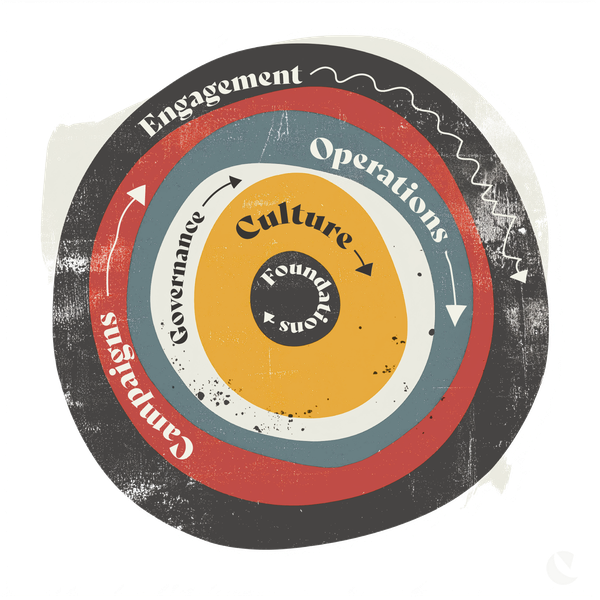
Foundation layer
This is the core of an organisation, the essence. Everything else rests on this.
Purpose and values (decades)
Content's role: content defines and articulates an organisation's reason for being and core beliefs.
Mission/vision statements: these foundational texts anchor everything an organisation does.
Values documentation: written expressions of ethical principles that guide decisions.
Origin stories: narratives that connect past to present and future.
Cultural layer
The culture of an organisation defines the way that it behaves.
Identity and voice (years)
Content's role: content embodies and evolves organisational culture.
Brand guidelines: documents that codify the organisation's personality.
Editorial style guides: systems that ensure consistency while allowing evolution.
Internal communications: content that reinforces or shifts cultural norms.
Thought leadership: expressions of the organisation's deeper perspective.
Governance layer
Governance help organisations function consistently over time.
Systems and standards (quarters to years)
Content's role: content establishes order and accountability.
Content policies: frameworks for what can and cannot be said.
Taxonomies: classification systems that organise knowledge.
Measurement frameworks: documents defining what success looks like.
Workflow documentation: processes that encode organisational practices.
Operational layer
How things are done within an organisation.
Practices and programs (weeks to months)
Content's role: content enables effective workflows and implementation.
Training materials: resources that build capacity and align practices.
Project documentation: records that capture decisions and progress.
Knowledge management: systems that preserve and transfer insights.
Content calendars: planning tools that coordinate efforts.
Campaign layer
Programmes of work with a particular, shorter-term aim.
Stories and initiatives (days to weeks)
Content's role: content drives coordinated action toward goals.
Campaign narratives: structured storytelling around specific objectives.
User journeys: designed content experiences that guide people.
Multi-channel assets: content adapted for different contexts and needs.
Event materials: resources supporting time-bound activities.
Engagement layer
The interactions between an organisation and world beyond its windows.
Conversations and responses (hours to days)
Content's role: content facilitates immediate connection and reaction.
Social media: real-time dialogue with communities.
News updates: timely information sharing.
Customer service: direct problem-solving interactions.
Community management: facilitated discussions among stakeholders.
The transformative power of content across layers
This perspective is doubly powerful once you look at how content can create connections between these layers:
Vertical integration
When fast-layer content (like social media) authentically reflects slow-layer content (like values statements), it creates coherence and builds trust.
Change propagation
Changes in content in one layer can catalyse transformations in adjacent layers – for example, updated governance documents can shift operational practices.
Diagnostic tool
Content inconsistencies across layers reveal organisational misalignments – for example when social content contradicts stated values.
Learning mechanism
Feedback from fast-layer content can inform the evolution of slower layers, allowing adaptation while maintaining identity.
The opportunity
A holistic view of content across pace layers gives a comprehensive framework for both understanding and guiding organisational transformation. This model can help recognise that meaningful change requires coordinated evolution across all levels, with content serving as both the manifestation and instrument of that change.