
A plan for Plan
Plan International UK wanted to improve the user experience of their content. They needed clarity on what content they had, what was working well, where improvements were needed and what needed to change.

As a purpose-driven organisation, you succeed or fail on your content. AI makes producing it faster; making it better everywhere (more effective, more persuasive, more you) needs an operating model.
For most of the organisations we work with, content doesn’t describe the work; it delivers it. The advice page is the advice, the report is the influence, the training module is the training. The content is the work.
When content quality determines the success or failure of your mission, the consequences of getting it wrong aren’t presentational. A page nobody can find isn’t a findability problem, it’s somebody who didn’t get to use a key statistic in a vital speech in parliament. A support PDF that won’t open on a phone isn’t an inconvenience, it’s a barrier at a moment of acute need.
The same holds inside the building: the bid, the policy, the job description, the chart everyone pastes into reports, the handover notes from the comms manager who left last year. This is the material your colleagues work from, and very little of it is designed. Most organisations have a publishing tool, some guidelines and a set of habits; often nobody has ever written down how the three fit together, nor decided if they apply to internal as well as external content.
Anyone who has put an AI agent to work knows what happens when you point a model at a job with no scaffolding around it. It produces something plausible, quickly, but it also makes mistakes, misses things out and you end up with slop.
A content operating model is the bespoke, informed scaffolding you need to ensure quality and effectiveness at the scale of a whole organisation: the work people do, the work agents do, and the handoffs and guardrails between them.
We design and build it, with AI and humans given defined jobs throughout each part: the seven questions your content operating model has to answer, the connections between them, and the system it all runs in. A better system produces better content, and better content is more of your mission delivered. We start by finding out where you stand.
Book an AI readiness review, £3,500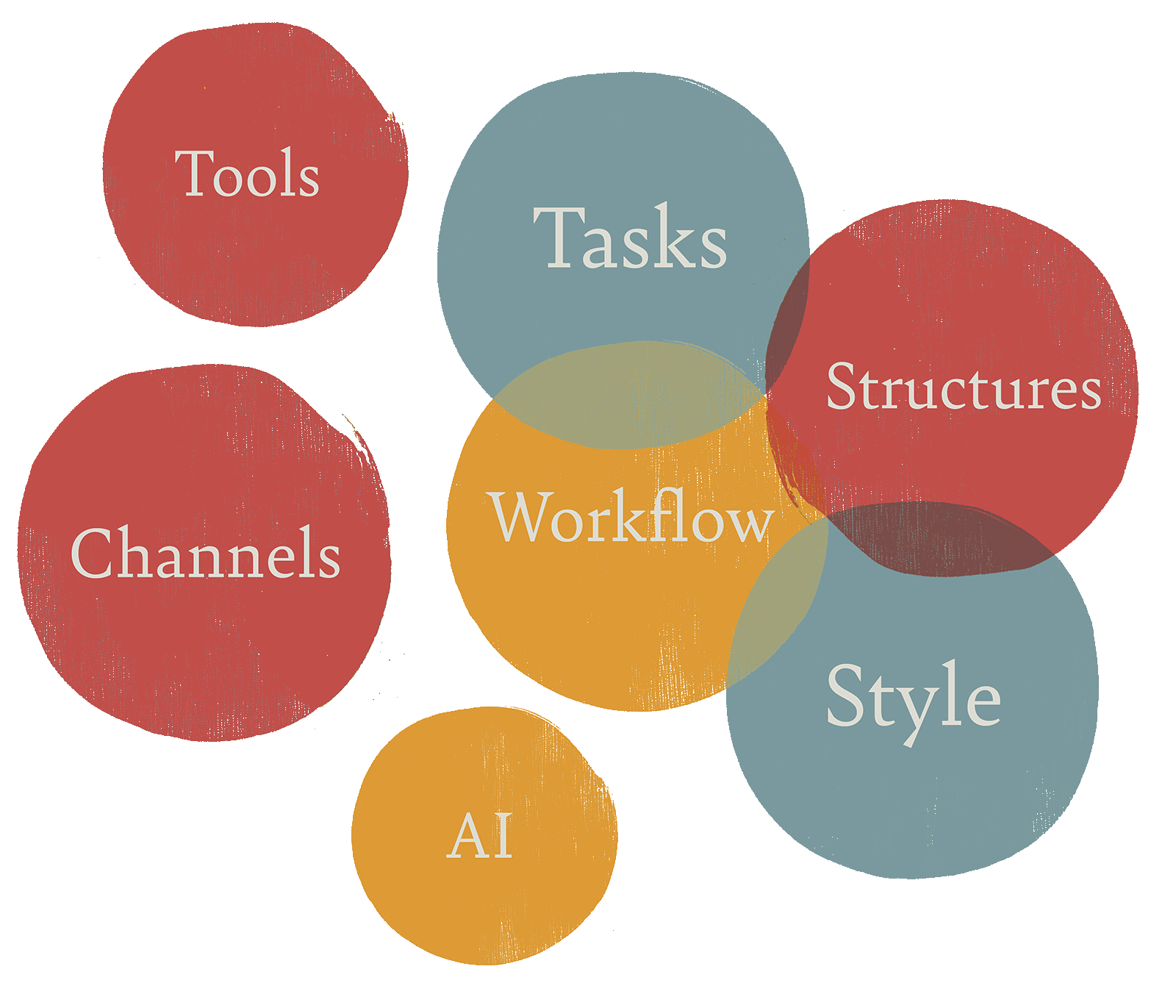
By the time a “content problem” reaches the more senior layers of an organisation it’s usually been renamed: a service that isn’t reaching people, a capacity problem, one part of the digital infrastructure that doesn’t speak to another. The fix is rarely a better writer.
If any of these sound familiar, you’d benefit from a better content operating model:
Our content operating models are built on the answers to seven questions. “Why?” is the strategic core: it sits in the middle and the other six connect to it. AI is woven throughout.
Each one has to have an answer that works both for what you publish and for what circulates inside the building.
Underneath sit two foundations the model depends on but doesn’t own: your essence, and your knowledge and opinions. Those belong to the whole organisation. We help clarify and distil those, then build the machinery on top, with the joining lines that carry your purpose and your expertise into the work.
“How?” and “By whom?” deserve more than a line of their own, because that’s often where most of the pain sits. Content needs somewhere it can be planned, assigned, drafted, reviewed, scheduled, maintained and eventually retired: a place where content is managed rather than merely published. And it needs clear roles and responsibilities for each of these life stages.
A content management system, despite the name, is usually a web publishing system, and asking it to run your content operation is why so many teams end up back in documents and email.
This is also where the internal half of the picture is made concrete. Nothing you send a colleague passes through a publishing step, which is why standards that hold on the website often evaporate the moment the work moves to a document.
We have strong opinions about which tools do this well and we’re glad to argue about them. We’ll also work flexibly with whatever you already own. The part we’re firm about is that the work needs a proper home.
When there’s an earthquake at seven in the morning, the content isn’t what holds you up. The decisions about who does what, who approves what and what good looks like were made before the emergency rather than during it.
The same people get more done, because the week stops being eaten by hunting for the current version and rewriting what already exists.
AI is a thought partner and an editor, working with all the organisation’s culture, norms, voice and brand style at its fingertips. Working together you create content you’re proud to put your name to, because there are reliable guidelines to check against and thought-through processes to make sure everything is as good as it can be.
AI agents also check proactively and inform the right people when there are issues that need fixing. The 78 pages that contradict the new government policy get found and fixed in an afternoon.
As an organisation you can achieve more, scaling up your reach and your impact. Your staff work better together, with clear roles and responsibilities, happily making the most of AI where it can provide real benefits. Leaders are secure in the knowledge that you have safeguards in place to ensure reliability and effectiveness.
None of this arrives by buying a tool. It’s as much a shift in culture and working practices as it is a technical project. Some people end up doing different work, and some roles change shape and title. We think that approaching this form of transformation with a content hat on is a better approach than a digital one.
We break content systems work into four parts. The first three are projects, and each one leaves you with something you can use, so you can stop after any of them. They’re priced separately and you only pay for the ones you take. The fourth part is a standing arrangement rather than a project and can begin after any of the others.
Where you stand, diagnosed and scored, and what to do about it.
Our Content Maturity assessment across a cross-section of your staff, a read of whatever documentation exists, and a Content Health Check sample of your live content.
You get your content operation scored across five areas, including how ready it is for the AI you’re being asked to adopt, a map of how work moves through your organisation as it happens rather than as the process document has it, and a ninety-day plan of six to ten prioritised moves with owners against them.
The Diagnose stage can be the foundation for further work or can stand on its own, leaving you to set up the recommended solutions.
The bespoke system fully designed, in a form people and machines can both act on.
The seven questions settled for your organisation: what content is for, how it’s modelled, where the decision points sit in each workflow, who holds which accountability by name, and standards an agent can check a draft against.
We’ll also work out where AI belongs in each part of it, and where it doesn’t, so the decision is made deliberately rather than by drift.
We’ll plan and run two workshops with the people who’ll live with the results and feed findings back to you.
You’ll get the full designs and specifications for a holistic system. Your team can build everything from here if you’d rather.
The model running.
A bespoke content system for humans and robots with all of your brand, strategy, structures and organisational knowledge built in.
Functionality combining planning, task management, a bird’s eye view of the state of play and personalised dashboards for everyone involved. A content calendar that integrates with your existing calendars. Versioning, suggested and tracked changes for editors. Notifications that arrive before the deadline rather than after it.
Standards an agent can read and check against for all content types, internal and external. Training so the people using it know why it works the way it does.
Best-in-class technology that’s easy to use, easy to adapt and inexpensive, with guidance baked in.
Somebody reads your numbers every month, talks it through with you and tells you what to do about them.
A content operating model isn’t a document you finish.
Content Health Check runs on your live content every month and turns up newly failing pages without being asked. Content Maturity gets re-scored once or twice a year, so that you can see what changed. We read both and come back with three things to do in order, and discuss what became of last month’s priorities. Once a year we go through the whole model properly and plan the next twelve months with you.
Whoever ends up owning the standards inside your organisation also gets somebody to ask, which is often the difference between a model that survives its first year and one that turns back into a PDF.
Half a day of our time a month, product access included, and anything beyond the half day is quoted separately. Workshops on a particular problem are £1,500 for two hours, including the preparation and the follow-up.
However large you are, and however complex your content needs, any of the project stages above can be scaled to fit. We’re used to working with large, international and federated organisations.
Translation and internationalisation add layers of complexity, and in those cases a content operation that scales matters more, not less. We’ll include a messaging framework and string management with localisation, so your content and your content teams can work across markets without the standards fragmenting.
Costs for working at scale are by conversation, because the shape depends on how many teams, markets and languages need to fit inside it. We’ll be happy to put together a bespoke package for you.
Content work is a loop and we’re in our element all the way around it. Somebody builds and maintains the system, someone plans, someone writes, somebody edits, somebody else signs off… Standards get encoded, models get tweaked for new platforms and formats and somebody studies the data about what happened. Contentious has the skills, experience and tools for all the parts of this loop. We’ve built and run digital teams and infrastructure, we’ve worked on transformation projects and we’ve written, edited and managed content and content systems for countless organisations.
Voice, Tone & Style is how you hold a voice when AI is drafting, Content Health Check is how you hold quality at AI volume, and Content Maturity tells you whether your organisation can run the loop at all.
Those are working products with paying users, built because the consultancy needed them and nothing on the market did the job.
We’ve been doing the underlying work for a long time, and at scale: a 12,000-page audit and a multi-year content transformation for the Internet Society, content models and governance for Global Witness, style guides and documentation for Greenpeace UK, the University of Nottingham and the Labour Party.
Content Maturity is free to use: a full assessment across five areas and 29 aspects, scored and written up, and you can invite up to five colleagues and see where you agree with each other and where you don’t. It takes about an hour and costs nothing. If you want to know whether you’re ready for the AI you’re being asked to adopt, that’s the fastest answer available.
The AI readiness review picks up where that leaves off. We run the assessment using a wider, representative cross-section of staff, from board members to content editors and from all parts of the organisation. We read whatever documentation exists, sample your live content with a Content Health Check, and map how work actually moves through your organisation as opposed to how the process document says it does. You end up with the score interpreted, the gaps explained, and a ninety-day plan of six to ten moves with a name against each one.
Assess your content maturityThe stages are priced separately, so it depends how far you want to go. Diagnose alone is £3,500, Diagnose and Transform together is from £15,500, and all three, ending with a system your team is running, starts at around £40,000. Tend is £1,000 a month and can start at any point, including instead of going further.
Nothing commits you to the next stage until you’ve seen what the last one produced. What moves a price above its floor is scope: how many teams, channels and languages are involved, and how much of the building we do as against your own team.
Yes, please do! Content Maturity is free: score yourself across five areas and 29 aspects, invite up to five colleagues, and see the combined picture. Sharing that with us will give us a great starting point.
Both, and the distinction matters less than it used to. The work is building a content operating model. AI is why it’s urgent, where much of the gain sits, and the thing most likely to expose the gaps if you skip it. If you have budget for AI readiness and none for content operations, this is one piece of work and you can call it either.
Many of the ingredients are, and you’ll recognise most of them: a style guide, a review date, a named owner, a workflow. What almost nobody has is the design, meaning how those parts connect, which of them answer to which, and where AI slots in, and doesn’t. A list of good practices and an operating model are different objects in the way that a pile of parts and a machine are different objects.
Somebody senior enough to make organisation-wide decisions and have the power to say no to things. In practice that’s often a head of communications or digital, but it could also be a head of operations, a head of transformation or a chief executive.
You have a holistic system for effective, quality content. But the world is shifting quickly and that’s what Tend is for: half a day a month, the products running underneath it, and an annual review that gives you a scheduled moment to decide on next year’s priorities.
Essentially, yes. One of them emphasises the operating model; the other, the systemic parts. We tend to use them interchangeably. Either covers what gets made and why, who decides, which standards apply, where the work happens, and what happens to a page in three years. Don’t confuse either term with a content management system, which is one tool sitting inside it.
No. The review looks at your operation, not your pages. If you want the content assessed too, Content Health Check does that, and the two together give you both halves.
For the review: around five to ten people for an hour each, plus one accountable person for a little over two hours in total. For a full project, a working group of three or four meeting fortnightly.
A reasonable position, and none of this depends on changing it. Everything we build works with all of it switched off, and the model does its job either way. Where AI does get switched on, your team picks where and how much, and the model is what makes that a decision instead of a drift.
The case behind all of this is set out in full in the content operating model in the AI age, which covers the three layers, the seven questions and why content is core infrastructure rather than a description of it. We’ve also written about why AI multiplies whatever operating model it lands in, over on Content Maturity. If you’re already convinced, the review is the place to start.
Book an AI readiness reviewSee system work in practice.